
Monday, October 29, 2012
Mad Scientists Showcase!
This nifty app will select a random collection of listings from Mad Scientists of Etsy shops. Every time you visit, they'll be a new treasury! We're going to add another page so you can get a random collection of handmade goodies from your favorite band of mad scientists anytime.

Friday, August 3, 2012
June - July Challenge Theme: Genetics
The theme for June / July was genetics. Only two team members tackled this challenge, but they were too good not to feature here.
First up is Helices, an original watercolor by Genevieve of SummerQuarters.
 I love the addition of the accessory proteins controlling DNA transcription and gene activity. The cheery orange-red background makes this a piece I can really see hanging in a doctor's office.
First up is Helices, an original watercolor by Genevieve of SummerQuarters.
Next up is this amazing collagen color spectrum by Kristin of ArtAtomic.

A color spectrum, based on the amino acid sequence of the protein Collagen. First, I wrote a program in Python, to analyze the amino acid frequencies in a sequence. Then I wrote a second program to visualize the results.It'll be really interesting to see how the spectra change depending on the size, composition and function of the protein scanned. I'd like to see some GPCRs and other transmembrane proteins to see how they differ from globular and structural proteins.
Kristin ran the code for insulin in her program next:

Hop of over to Kristin's blog for more details.
The challenge theme for August / September is Hypatia of Alexandria - what are you going to create?
Wednesday, June 13, 2012
April/May Challenge Treasury!
You might recall that the challenge item for April (and May) was the world's tiniest vertebrate. Here's what we cooked up!
'The World's Tiniest Frog!' by Kokoba
 |  |  |  |
 |  |  |  |
 |  |  |  |
 |  |  |  |
Treasury tool supported by the dog house
Thursday, May 10, 2012
Is Philosophy Important For Scientists?
Great article from the Physics Buzz blog about science and philosophy.
This one hits home for me because I earned my undergraduate degree in philosophy, perhaps the poster child for "useless majors" (up there with dance and art history). xkcd even lists it first in the parody song "Every Major's Terrible." (Click the image to see the comic full-size.)

It's a shame, really, because I consider it incredibly useful. (Never mind that Randall's stereotyped depiction of philosophy is way far off the mark.) Here's a few reasons.
Not everyone becomes scientists, or programmers, or engineers, but everyone engages in debates of some kind or another. Most everyone reads the news, posts on forums or blogs, votes in elections, or failing that, has conversations with their friends. We see advertisements and commercials constantly: we are bombarded with persuasive arguments and rhetoric to convince us to vote for a certain candidate or to buy a certain shampoo. How stupid it is to be ill-equipped to cope with them!
It would be impractical for everyone to go back to school and earn a B.A. in philosophy just to deal with this situation, however, so here's few good references:
Philosophy is broad enough that it can be applied to almost anything. And I do mean anything.
Within the broader field of philosophy, there's epistemology (the study of knowledge), ethics, aesthetics, and metaphysics* (the study of the nature of reality). There's something there for everybody! If you're at all a thoughtful individual, you've wondered about issues that fall under one or more of those headings. Even a basic Philosophy 101 class can provide a better set of concepts and vocabulary you can use to express yourself and explain your opinion: consequential, utilitarian, and deontological are just the beginning!
References to philosophical problems, quandaries, and puzzles happen all the time in popular culture. Granted, if you waste spend your time consuming Jersey Shore or Flava of Love you probably won't encounter much Sartres or Jean-Jacques Rousseau. The perennial favorite to cite at this point would be The Matrix and how it relates to Plato's allegory of the cave, or Descartes' evil genius, or whatever else people manage to read into that movie.
Even without straight-up references, a basic knowledge of Western philosophical concepts and treatises definitely adds a new layer to almost anything. Reading about John Locke's theory of identity right before watching Christopher Nolan's Memento made it much different than it would have been otherwise—I'd even venture to say better than it would have been otherwise. Spending an entire semester writing a senior philosophy thesis on Philip K. Dick's Do Androids Dream of Electric Sheep? and the moral and ethical quandaries of just one scene deepened my appreciation of the entire book.
Never mind this bit from Monty Python! (NSFW) (I once quoted this, in its entirety, in a final exam for a Survey of Modern Philosophy course because I thought my answer looked too short.)
And if that isn't enough, here's the story of Ilya Prigogine, a Nobel Prize winner in chemistry. Among other things, he's responsible for the concepts of dissipative structures and self-organizing systems. I read his story in Creativity not a day after I wrote the first draft of this entry.
As a child, Prigogine was interested in the humanities (philosophy, art, and music specifically) but at the behest of his parents studied law. Law led to an interest in criminal psychology, which led him to try to better understand the brain through neurochemistry, a topic which he continued to frame through philosophical issues such as choice, responsibility, and freedom.
*"Metaphysics" has been co-opted by a lot of "woo" writers and, as a result, has developed some unfortunate "woo" connotations. Most volumes billing themselves as somehow metaphysical in nature, or tackling metaphysics, are often lacking in the intellectual and academic rigor that is the trademark of "actual" philosophy. Be careful!
This one hits home for me because I earned my undergraduate degree in philosophy, perhaps the poster child for "useless majors" (up there with dance and art history). xkcd even lists it first in the parody song "Every Major's Terrible." (Click the image to see the comic full-size.)
It's a shame, really, because I consider it incredibly useful. (Never mind that Randall's stereotyped depiction of philosophy is way far off the mark.) Here's a few reasons.
1. Critical Thinking Skills
Not everyone becomes scientists, or programmers, or engineers, but everyone engages in debates of some kind or another. Most everyone reads the news, posts on forums or blogs, votes in elections, or failing that, has conversations with their friends. We see advertisements and commercials constantly: we are bombarded with persuasive arguments and rhetoric to convince us to vote for a certain candidate or to buy a certain shampoo. How stupid it is to be ill-equipped to cope with them!
It would be impractical for everyone to go back to school and earn a B.A. in philosophy just to deal with this situation, however, so here's few good references:
- Take a magical journey through the land of logical fallacies and get caught up on poor argumentative techniques with this series from Skeptoid.
- San Jose State University has a good page documenting the nuts and bolts of an argument.
- Once you've learned how to spot poor arguments and logical fallacies, you can use a link to YourLogicalFallacyIs.com to educate others! At least when you're arguing online.
2. Self-Expression
Philosophy is broad enough that it can be applied to almost anything. And I do mean anything.
 |
| Arguably this might be taking it too far. |
Within the broader field of philosophy, there's epistemology (the study of knowledge), ethics, aesthetics, and metaphysics* (the study of the nature of reality). There's something there for everybody! If you're at all a thoughtful individual, you've wondered about issues that fall under one or more of those headings. Even a basic Philosophy 101 class can provide a better set of concepts and vocabulary you can use to express yourself and explain your opinion: consequential, utilitarian, and deontological are just the beginning!
3. Enriching Experiences
References to philosophical problems, quandaries, and puzzles happen all the time in popular culture. Granted, if you Even without straight-up references, a basic knowledge of Western philosophical concepts and treatises definitely adds a new layer to almost anything. Reading about John Locke's theory of identity right before watching Christopher Nolan's Memento made it much different than it would have been otherwise—I'd even venture to say better than it would have been otherwise. Spending an entire semester writing a senior philosophy thesis on Philip K. Dick's Do Androids Dream of Electric Sheep? and the moral and ethical quandaries of just one scene deepened my appreciation of the entire book.
Never mind this bit from Monty Python! (NSFW) (I once quoted this, in its entirety, in a final exam for a Survey of Modern Philosophy course because I thought my answer looked too short.)
4. Be A Better ________ (In This Case, Scientist)
I'm just going to quote from Albert Einstein on this one:
"I fully agree with you about the significance and educational value of methodology as well as history and philosophy of science. So many people today—and even professional scientists—seem to me like somebody who has seen thousands of trees but has never seen a forest. A knowledge of the historic and philosophical background gives that kind of independence from prejudices of his generation from which most scientists are suffering. This independence created by philosophical insight is—in my opinion—the mark of distinction between a mere artisan or specialist and a real seeker after truth."
As a child, Prigogine was interested in the humanities (philosophy, art, and music specifically) but at the behest of his parents studied law. Law led to an interest in criminal psychology, which led him to try to better understand the brain through neurochemistry, a topic which he continued to frame through philosophical issues such as choice, responsibility, and freedom.
"If you can say that the universe is deterministic, a kind of automaton, then how can we hold to the idea of responsibility? All of Western philosophy was dominated by this problem. It seemed to me that we had to choose between a scientific view which was negating humanistic tradition, or a humanistic tradition which was trying to destroy what we learned from science...I was very sensitive to this conflict because I came to science, to hard science, from the human sciences...But what I learned from thermodynamics confirmed my philosophical point of view. And gave me the energy to continue to look on a deeper interpretation of time and of the laws of nature. So, I would say, it is a kind of feedback between the humanistic and the scientific point of view."
5. Fending Off Hubris
Most importantly (especially for scientists), philosophy reminds us that there is and always will be a realm of questions for which there are no clear, objective answers. Not merely trivial things like, "Which is the best flavor of ice cream?" or "Who was the worst Bond?" but big things, too: "What is a good life?" "Do you save the train car full of old people or the train car full of babies?" "What is free will? Do we have it?"
Science has done a lot for us this past century, and the work of scientists has improved life immeasurably. While there is a radical, minority fringe that insists on demonizing science and remaining staunchly ignorant of how it works, within mainstream society the field of science enjoys a fair amount of privilege. Scientists can point to a long list of tangible modern accomplishments and improvements that spring directly from their field, no matter what that field may be. There's definitely a lot to be proud of.
Because of this history, there is the tendency for science to get full of itself. A belief that if science can solve so many problems, it can surely solve all of the problems; that somehow scientists have a super-privileged insight into the human condition that the rest of us lack.Unchecked, that mindset can become one of the most obnoxious, intolerable characteristics in a person. (I'm looking at you, Richard Dawkins.) Regularly engaging with something one doesn't understand is probably one of the best ways to avoid becoming a boorish jackass. (Again: I'm looking at you, Richard Dawkins.)
If nothing else, you never know when philosophy will come in handy on Jeopardy! or at bar trivia.
*"Metaphysics" has been co-opted by a lot of "woo" writers and, as a result, has developed some unfortunate "woo" connotations. Most volumes billing themselves as somehow metaphysical in nature, or tackling metaphysics, are often lacking in the intellectual and academic rigor that is the trademark of "actual" philosophy. Be careful!
Thursday, April 26, 2012
National Physics Day!
In case you didn't know, this past Tuesday was National Physics Day. Of course, for us here at the Mad Scientists of Etsy, every day is Physics Day (and Chemistry Day, and Astronomy Day, and Biology Day...). Here are some great items, from the Mad Scientists and laypeople alike, that celebrate the beauty that is physics.
'Physics Day!' by Kokoba
 |  |  |  |
 |  |  |  |
 |  |  |  |
 |  |  |  |
Thursday, April 19, 2012
Etsy Shop of the Day: Fender Minerals
According to my mom, I was fascinated by rocks and minerals even at an early age. I don't remember much from those years of my life, and during my middle and high school years I didn't give a second thought to rocks. It wasn't until I started working at a rock and mineral shop in college that my fascination reasserted itself. Since then, my appreciation for the gorgeousness lurking in the crust beneath our feet has only deepened. Nothing makes my day like pretty rocks and mineral samples.
Fender Minerals has so many beautiful items I don't even know where to begin. While not a Mad Scientist of Etsy (yet?), Ms. Fender has some gorgeous samples that are of interest to any of our mad scientist rockhounds (yours truly, for example). Check out, for instance, this gorgeous piece of malachite (already one of my favorite stones):
The little crystals in there are awesome! I've never seen that in malachite before. Alas the piece looks a little dinged up, but malachite is so soft it's really inevitable that it gets scratched.
Something like this would be great in a little knick-knacks display shelf. This is what you'll find in my curios cabinet when I'm an old lady—not creepy ceramic children.
If you want more pictures and information, check out Fender Minerals' blog. There's a lot more to be had over there.
Fender Minerals has so many beautiful items I don't even know where to begin. While not a Mad Scientist of Etsy (yet?), Ms. Fender has some gorgeous samples that are of interest to any of our mad scientist rockhounds (yours truly, for example). Check out, for instance, this gorgeous piece of malachite (already one of my favorite stones):
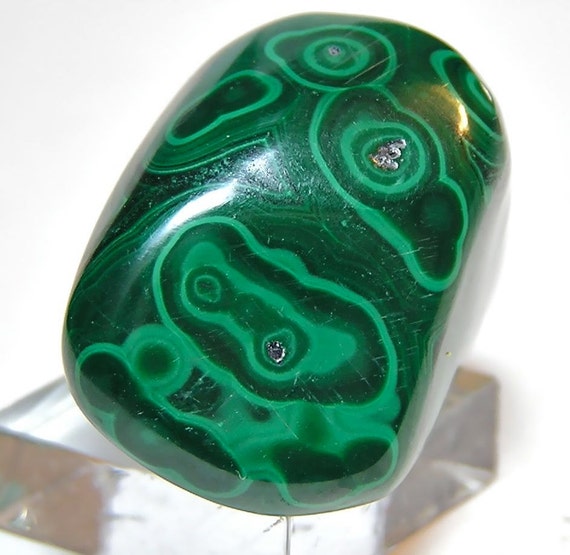 |
| Polished Bullseye Malachite Nugget from Fender Minerals |
The little crystals in there are awesome! I've never seen that in malachite before. Alas the piece looks a little dinged up, but malachite is so soft it's really inevitable that it gets scratched.
If green's not to your taste, there's always iridescent chalcopyrite—the aptly named "Peacock Ore."
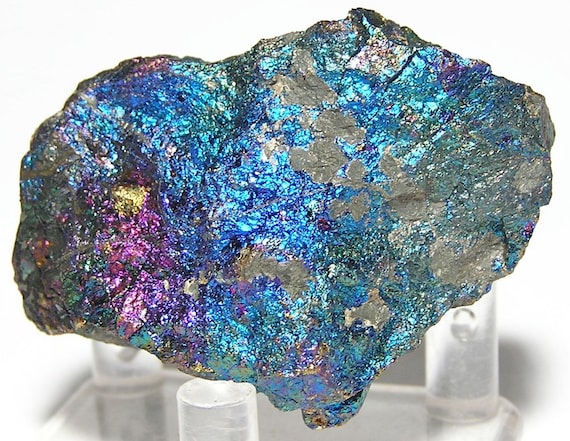 |
| Peacock Ore Chalcopyrite Ray Mine Specimen from Fender Minerals |
Something like this would be great in a little knick-knacks display shelf. This is what you'll find in my curios cabinet when I'm an old lady—not creepy ceramic children.
Fender Minerals also carries polished fossils that are drilled and ready for beading or wire-wrapping. Here's one of my favorites, an orthocera.
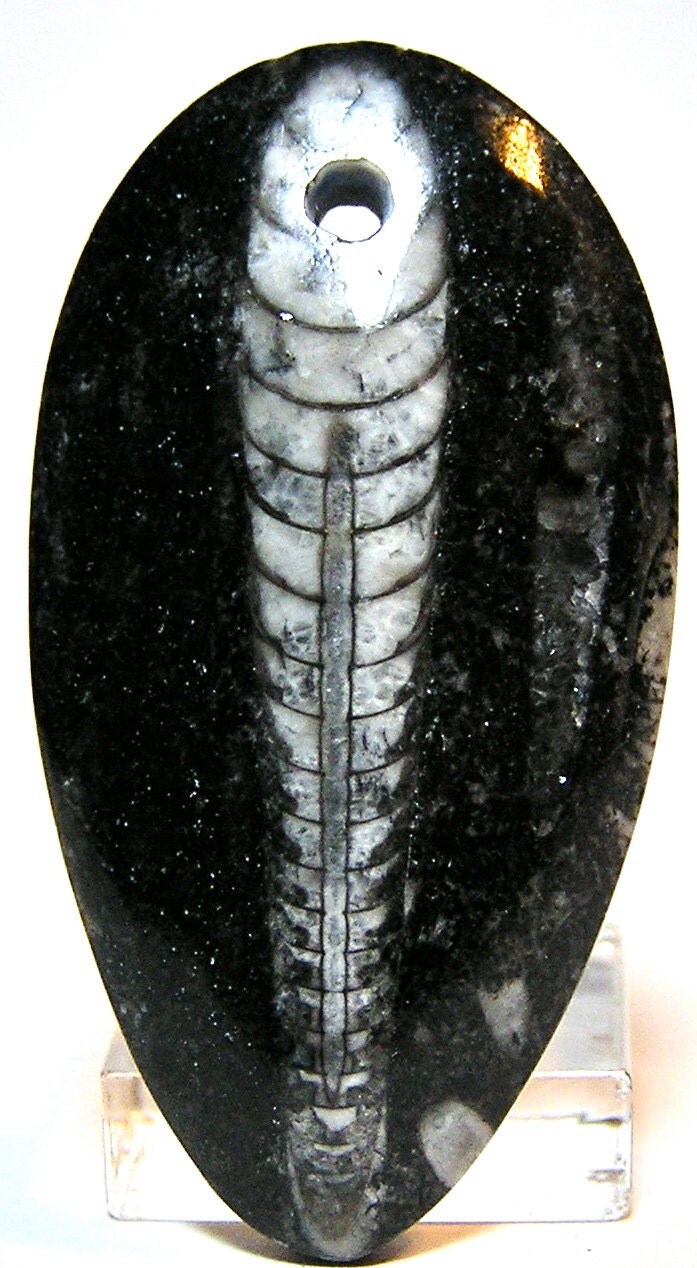 |
| Orthocera Fossil from Fender Minerals |
Thursday, April 12, 2012
April Challenge Theme: World's Tiniest Vertebrate Found!
Scientists in New Guinea recently discovered the world's tiniest vertebrate: a frog that reaches a whopping 7.7 mm in length.

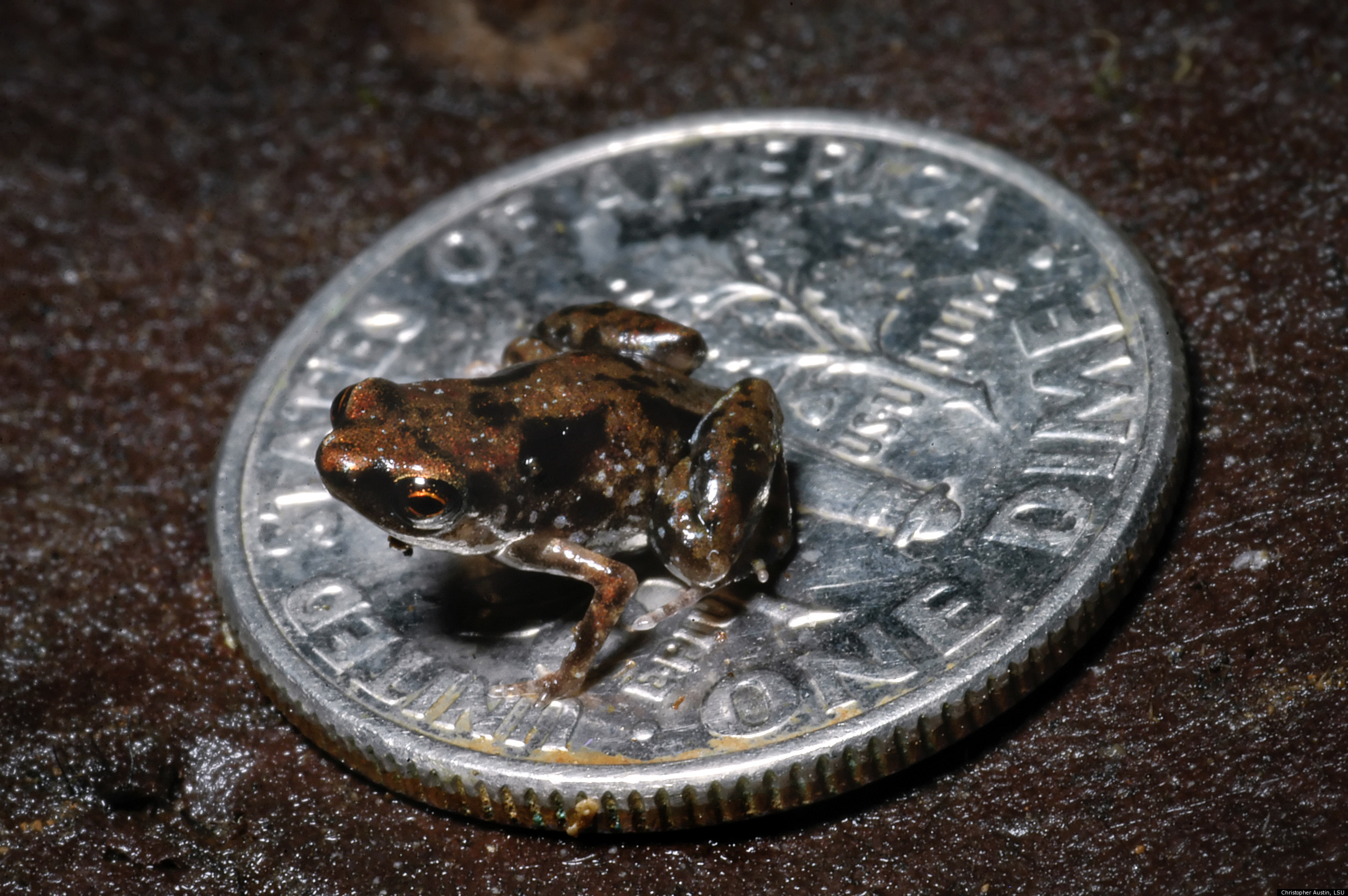
Look at him! I can't deal with adorable he is! Neither can we, apparently, so for the rest of April the Mad Scientists will be crafting up a huge (tiny) storm.
What do you think would be a cool crafty idea to celebrate this miniature amphibian?
Subscribe to:
Posts (Atom)
LinkWithin
