Showing posts with label kokoba. Show all posts
Thursday, March 14, 2013
Happy Pi Day!
It's March 14th, also known as 3.14 or Pi Day! Here's some pi-inspired items from the Mad Scientists of Etsy.
Labels:
buffalonerdproject,
kokoba,
LeftBrainRightBrain,
math,
msoe team,
nikhajewelry,
numbers,
pangaeadesigns,
Pi,
Pi Day,
Polymath
Monday, December 3, 2012
What does silk sound like?
Silk is an awesome feat of nature. We can use it for everything from Kevlar to fancy evening dresses, and now we can even listen to it!
Scientists at MIT are mapping spider silk proteins on to musical scores not only for fun, but as a way to understand the structure of any given silk "recipe" and to predict how it might pan out in real life. How cool is that? Skip to the middle of the video to "hear" the silk!
Wednesday, June 13, 2012
April/May Challenge Treasury!
You might recall that the challenge item for April (and May) was the world's tiniest vertebrate. Here's what we cooked up!
'The World's Tiniest Frog!' by Kokoba
|
$25.00
|
$5.00
|
$16.00
|
$16.00
|
|
$5.50
|
$50.00
|
$60.00
|
$20.00
|
|
$50.00
|
$6.00
|
$6.00
|
$15.00
|
|
$15.00
|
$20.00
|
$25.00
|
$24.00
|
Treasury tool supported by the dog house
Thursday, May 10, 2012
Is Philosophy Important For Scientists?
Great article from the Physics Buzz blog about science and philosophy.
This one hits home for me because I earned my undergraduate degree in philosophy, perhaps the poster child for "useless majors" (up there with dance and art history). xkcd even lists it first in the parody song "Every Major's Terrible." (Click the image to see the comic full-size.)
It's a shame, really, because I consider it incredibly useful. (Never mind that Randall's stereotyped depiction of philosophy is way far off the mark.) Here's a few reasons.
Not everyone becomes scientists, or programmers, or engineers, but everyone engages in debates of some kind or another. Most everyone reads the news, posts on forums or blogs, votes in elections, or failing that, has conversations with their friends. We see advertisements and commercials constantly: we are bombarded with persuasive arguments and rhetoric to convince us to vote for a certain candidate or to buy a certain shampoo. How stupid it is to be ill-equipped to cope with them!
It would be impractical for everyone to go back to school and earn a B.A. in philosophy just to deal with this situation, however, so here's few good references:
Philosophy is broad enough that it can be applied to almost anything. And I do mean anything.
Within the broader field of philosophy, there's epistemology (the study of knowledge), ethics, aesthetics, and metaphysics* (the study of the nature of reality). There's something there for everybody! If you're at all a thoughtful individual, you've wondered about issues that fall under one or more of those headings. Even a basic Philosophy 101 class can provide a better set of concepts and vocabulary you can use to express yourself and explain your opinion: consequential, utilitarian, and deontological are just the beginning!
References to philosophical problems, quandaries, and puzzles happen all the time in popular culture. Granted, if you waste spend your time consuming Jersey Shore or Flava of Love you probably won't encounter much Sartres or Jean-Jacques Rousseau. The perennial favorite to cite at this point would be The Matrix and how it relates to Plato's allegory of the cave, or Descartes' evil genius, or whatever else people manage to read into that movie.
Even without straight-up references, a basic knowledge of Western philosophical concepts and treatises definitely adds a new layer to almost anything. Reading about John Locke's theory of identity right before watching Christopher Nolan's Memento made it much different than it would have been otherwise—I'd even venture to say better than it would have been otherwise. Spending an entire semester writing a senior philosophy thesis on Philip K. Dick's Do Androids Dream of Electric Sheep? and the moral and ethical quandaries of just one scene deepened my appreciation of the entire book.
Never mind this bit from Monty Python! (NSFW) (I once quoted this, in its entirety, in a final exam for a Survey of Modern Philosophy course because I thought my answer looked too short.)
And if that isn't enough, here's the story of Ilya Prigogine, a Nobel Prize winner in chemistry. Among other things, he's responsible for the concepts of dissipative structures and self-organizing systems. I read his story in Creativity not a day after I wrote the first draft of this entry.
As a child, Prigogine was interested in the humanities (philosophy, art, and music specifically) but at the behest of his parents studied law. Law led to an interest in criminal psychology, which led him to try to better understand the brain through neurochemistry, a topic which he continued to frame through philosophical issues such as choice, responsibility, and freedom.
*"Metaphysics" has been co-opted by a lot of "woo" writers and, as a result, has developed some unfortunate "woo" connotations. Most volumes billing themselves as somehow metaphysical in nature, or tackling metaphysics, are often lacking in the intellectual and academic rigor that is the trademark of "actual" philosophy. Be careful!
This one hits home for me because I earned my undergraduate degree in philosophy, perhaps the poster child for "useless majors" (up there with dance and art history). xkcd even lists it first in the parody song "Every Major's Terrible." (Click the image to see the comic full-size.)
It's a shame, really, because I consider it incredibly useful. (Never mind that Randall's stereotyped depiction of philosophy is way far off the mark.) Here's a few reasons.
1. Critical Thinking Skills
Not everyone becomes scientists, or programmers, or engineers, but everyone engages in debates of some kind or another. Most everyone reads the news, posts on forums or blogs, votes in elections, or failing that, has conversations with their friends. We see advertisements and commercials constantly: we are bombarded with persuasive arguments and rhetoric to convince us to vote for a certain candidate or to buy a certain shampoo. How stupid it is to be ill-equipped to cope with them!
It would be impractical for everyone to go back to school and earn a B.A. in philosophy just to deal with this situation, however, so here's few good references:
- Take a magical journey through the land of logical fallacies and get caught up on poor argumentative techniques with this series from Skeptoid.
- San Jose State University has a good page documenting the nuts and bolts of an argument.
- Once you've learned how to spot poor arguments and logical fallacies, you can use a link to YourLogicalFallacyIs.com to educate others! At least when you're arguing online.
2. Self-Expression
Philosophy is broad enough that it can be applied to almost anything. And I do mean anything.
| Arguably this might be taking it too far. |
Within the broader field of philosophy, there's epistemology (the study of knowledge), ethics, aesthetics, and metaphysics* (the study of the nature of reality). There's something there for everybody! If you're at all a thoughtful individual, you've wondered about issues that fall under one or more of those headings. Even a basic Philosophy 101 class can provide a better set of concepts and vocabulary you can use to express yourself and explain your opinion: consequential, utilitarian, and deontological are just the beginning!
3. Enriching Experiences
References to philosophical problems, quandaries, and puzzles happen all the time in popular culture. Granted, if you Even without straight-up references, a basic knowledge of Western philosophical concepts and treatises definitely adds a new layer to almost anything. Reading about John Locke's theory of identity right before watching Christopher Nolan's Memento made it much different than it would have been otherwise—I'd even venture to say better than it would have been otherwise. Spending an entire semester writing a senior philosophy thesis on Philip K. Dick's Do Androids Dream of Electric Sheep? and the moral and ethical quandaries of just one scene deepened my appreciation of the entire book.
Never mind this bit from Monty Python! (NSFW) (I once quoted this, in its entirety, in a final exam for a Survey of Modern Philosophy course because I thought my answer looked too short.)
4. Be A Better ________ (In This Case, Scientist)
I'm just going to quote from Albert Einstein on this one:
"I fully agree with you about the significance and educational value of methodology as well as history and philosophy of science. So many people today—and even professional scientists—seem to me like somebody who has seen thousands of trees but has never seen a forest. A knowledge of the historic and philosophical background gives that kind of independence from prejudices of his generation from which most scientists are suffering. This independence created by philosophical insight is—in my opinion—the mark of distinction between a mere artisan or specialist and a real seeker after truth."
As a child, Prigogine was interested in the humanities (philosophy, art, and music specifically) but at the behest of his parents studied law. Law led to an interest in criminal psychology, which led him to try to better understand the brain through neurochemistry, a topic which he continued to frame through philosophical issues such as choice, responsibility, and freedom.
"If you can say that the universe is deterministic, a kind of automaton, then how can we hold to the idea of responsibility? All of Western philosophy was dominated by this problem. It seemed to me that we had to choose between a scientific view which was negating humanistic tradition, or a humanistic tradition which was trying to destroy what we learned from science...I was very sensitive to this conflict because I came to science, to hard science, from the human sciences...But what I learned from thermodynamics confirmed my philosophical point of view. And gave me the energy to continue to look on a deeper interpretation of time and of the laws of nature. So, I would say, it is a kind of feedback between the humanistic and the scientific point of view."
5. Fending Off Hubris
Most importantly (especially for scientists), philosophy reminds us that there is and always will be a realm of questions for which there are no clear, objective answers. Not merely trivial things like, "Which is the best flavor of ice cream?" or "Who was the worst Bond?" but big things, too: "What is a good life?" "Do you save the train car full of old people or the train car full of babies?" "What is free will? Do we have it?"
Science has done a lot for us this past century, and the work of scientists has improved life immeasurably. While there is a radical, minority fringe that insists on demonizing science and remaining staunchly ignorant of how it works, within mainstream society the field of science enjoys a fair amount of privilege. Scientists can point to a long list of tangible modern accomplishments and improvements that spring directly from their field, no matter what that field may be. There's definitely a lot to be proud of.
Because of this history, there is the tendency for science to get full of itself. A belief that if science can solve so many problems, it can surely solve all of the problems; that somehow scientists have a super-privileged insight into the human condition that the rest of us lack.Unchecked, that mindset can become one of the most obnoxious, intolerable characteristics in a person. (I'm looking at you, Richard Dawkins.) Regularly engaging with something one doesn't understand is probably one of the best ways to avoid becoming a boorish jackass. (Again: I'm looking at you, Richard Dawkins.)
If nothing else, you never know when philosophy will come in handy on Jeopardy! or at bar trivia.
*"Metaphysics" has been co-opted by a lot of "woo" writers and, as a result, has developed some unfortunate "woo" connotations. Most volumes billing themselves as somehow metaphysical in nature, or tackling metaphysics, are often lacking in the intellectual and academic rigor that is the trademark of "actual" philosophy. Be careful!
Thursday, April 26, 2012
National Physics Day!
In case you didn't know, this past Tuesday was National Physics Day. Of course, for us here at the Mad Scientists of Etsy, every day is Physics Day (and Chemistry Day, and Astronomy Day, and Biology Day...). Here are some great items, from the Mad Scientists and laypeople alike, that celebrate the beauty that is physics.
'Physics Day!' by Kokoba
|
$14.00
|
$4.95
|
$265.00
|
$399.00
|
|
$35.00
|
$14.99
|
$19.95
|
$48.00
|
|
$20.00
|
$6.00
|
$26.00
|
$8.00
|
|
$25.00
|
$25.00
|
$29.99
|
$12.00
|
Thursday, April 19, 2012
Etsy Shop of the Day: Fender Minerals
According to my mom, I was fascinated by rocks and minerals even at an early age. I don't remember much from those years of my life, and during my middle and high school years I didn't give a second thought to rocks. It wasn't until I started working at a rock and mineral shop in college that my fascination reasserted itself. Since then, my appreciation for the gorgeousness lurking in the crust beneath our feet has only deepened. Nothing makes my day like pretty rocks and mineral samples.
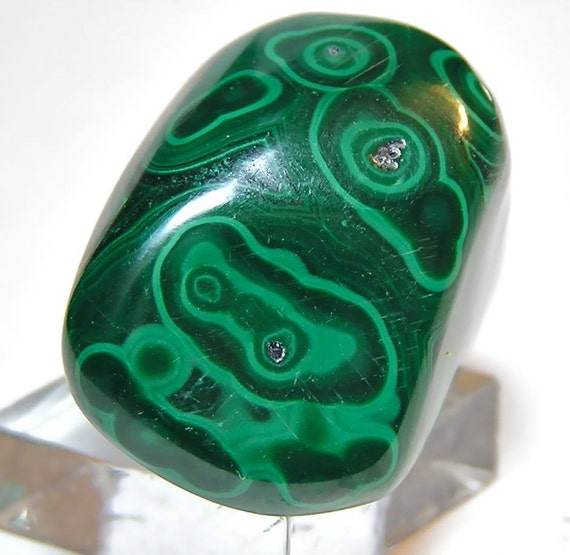
Fender Minerals has so many beautiful items I don't even know where to begin. While not a Mad Scientist of Etsy (yet?), Ms. Fender has some gorgeous samples that are of interest to any of our mad scientist rockhounds (yours truly, for example). Check out, for instance, this gorgeous piece of malachite (already one of my favorite stones):
The little crystals in there are awesome! I've never seen that in malachite before. Alas the piece looks a little dinged up, but malachite is so soft it's really inevitable that it gets scratched.
Something like this would be great in a little knick-knacks display shelf. This is what you'll find in my curios cabinet when I'm an old lady—not creepy ceramic children.
If you want more pictures and information, check out Fender Minerals' blog. There's a lot more to be had over there.
Fender Minerals has so many beautiful items I don't even know where to begin. While not a Mad Scientist of Etsy (yet?), Ms. Fender has some gorgeous samples that are of interest to any of our mad scientist rockhounds (yours truly, for example). Check out, for instance, this gorgeous piece of malachite (already one of my favorite stones):
| Polished Bullseye Malachite Nugget from Fender Minerals |
The little crystals in there are awesome! I've never seen that in malachite before. Alas the piece looks a little dinged up, but malachite is so soft it's really inevitable that it gets scratched.
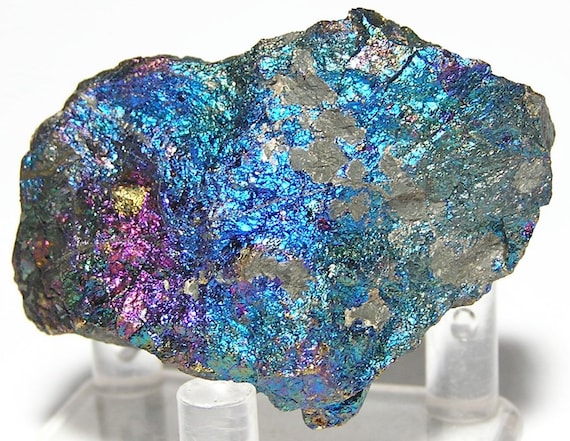
If green's not to your taste, there's always iridescent chalcopyrite—the aptly named "Peacock Ore."
| Peacock Ore Chalcopyrite Ray Mine Specimen from Fender Minerals |
Something like this would be great in a little knick-knacks display shelf. This is what you'll find in my curios cabinet when I'm an old lady—not creepy ceramic children.
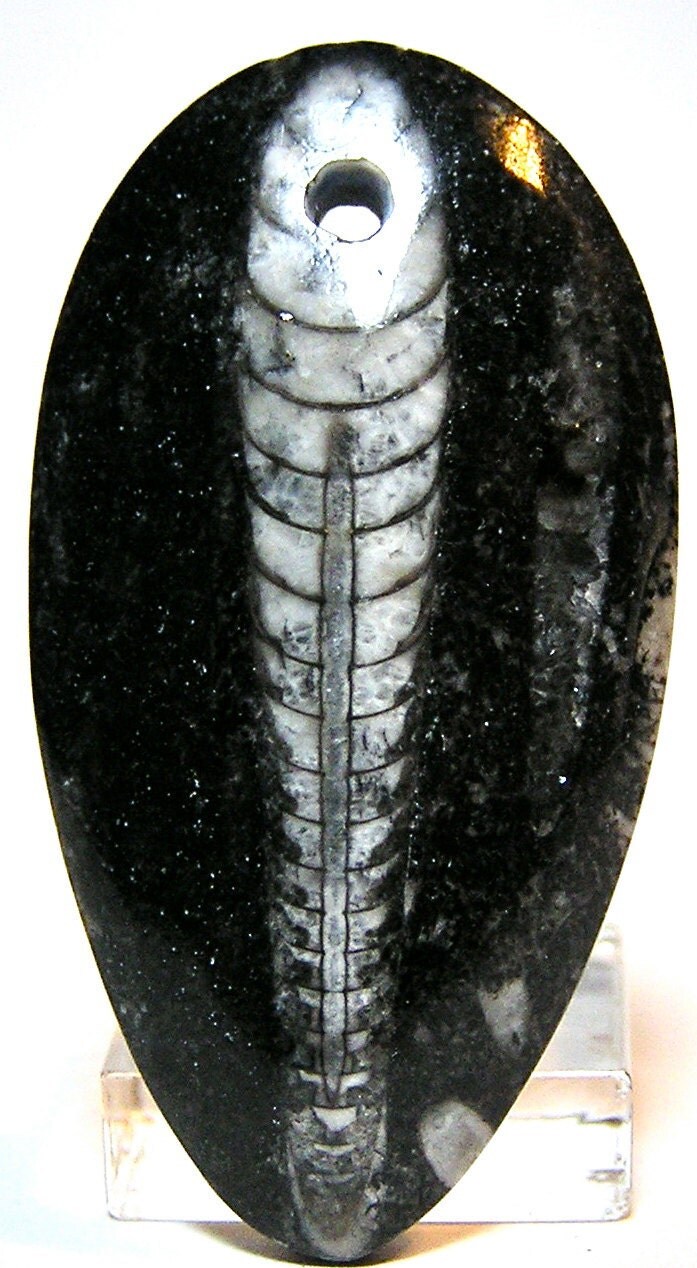
Fender Minerals also carries polished fossils that are drilled and ready for beading or wire-wrapping. Here's one of my favorites, an orthocera.
| Orthocera Fossil from Fender Minerals |
Thursday, April 12, 2012
April Challenge Theme: World's Tiniest Vertebrate Found!
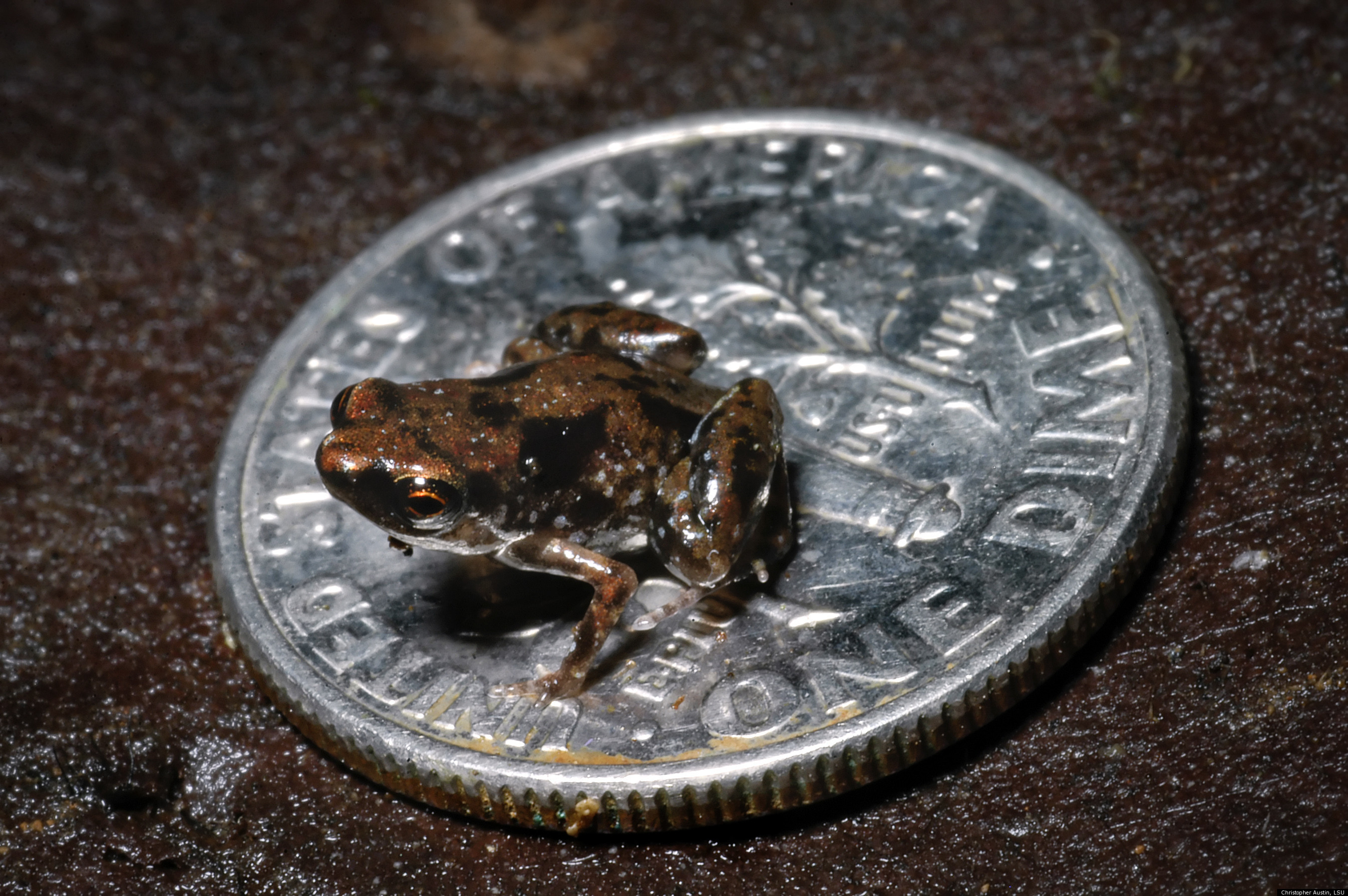
Scientists in New Guinea recently discovered the world's tiniest vertebrate: a frog that reaches a whopping 7.7 mm in length.
Look at him! I can't deal with adorable he is! Neither can we, apparently, so for the rest of April the Mad Scientists will be crafting up a huge (tiny) storm.
What do you think would be a cool crafty idea to celebrate this miniature amphibian?
Labels:
biology,
contest,
kokoba,
mad scientists of etsy
Thursday, April 5, 2012
Documentary Review: Playing God
I put off watching this one for a while because the title was just so dumb, honestly. Phrases like "playing God" and so forth perpetuate this image of science as a reckless, thoughtless endeavor; a field of study full of people who don't consider the consequences or repercussions of what they do. It paints this image of science as something that will ultimately doom us all and glosses over all of the good that science has brought us.
It's doubly unfortunate that Playing God has such a stupid title, then, because it's seriously the most amazing thing I've seen in a while. All of the documentaries I've watched so far have been good, of course, but this is the first that made me go, "Holy shit!"
It's another BBC production, this time hosted by Adam Rutherford. This one is all about genetics and what amazing things scientists are doing with gene splicing: goats that produce tougher-than-Kevlar spider silk in their milk, radiation treatment in tiny carbon capsules injected under astronauts' skin, purely synthetic materials created with squid camouflaging genes that will change color from the carbon dioxide in your breath, brewer's yeast that make petroleum instead of alcohol. Everything in here sounds like the stuff of science fiction, and yet scientists are creating this today.
The good: Everything. Just...everything. It also raises legitimate ethical concerns, not fluffy fear-mongering.
The bad: The documentary gives a little too much credence to the "are we meddling with what we should not?" view in some places, but for the most part avoids that trap entirely.
One interesting fact: It was all interesting, but I think my favorite part was the "citizen science" lab that was set up in the community center of some town in California. For a small membership fee, John Q. Public can now perform science experiments that, just a few years ago, were only possible to do in university laboratories. I wish something like that had been available when I was a kid!
Would recommend? A must-see. Put your NetFlix queue on hold and watch this one tonight. Seriously.
Wednesday, February 29, 2012
Documentary Review: The Core
It's been quiet 'round these parts, hasn't it? Let's jump start things with a movie recommendation!
A few years ago, I set a goal for myself to watch one documentary and read one non-fiction book a month. I've slacked off once in a while, but the net result has been that I've seen a lot of neat documentaries I wouldn't have seen otherwise! All of the ones I'm going to mention here are available—for free!—on DocumentaryHeaven.com. So you, too, can watch at your leisure!
First up: The Core
Just what is inside our planet? Not to be confused with the schlocky Hollywood movie, this is a slick BBC documentary that slices off the crust and takes us as close as we can get to the Earth's molten center.
The good: Always very interesting and engaging. I mean, I think the molten core of the Earth is already super interesting, but I think they did a good job of making it accessible and entertaining for people who don't think so. Plus sometimes there are explosions!
The bad: There's a bit too much in terms of attempting to create "dramatic tension" or whatever: an over-acted sense of urgency in the narrator's voice, melodramatic music, and so forth. It got kind of cheesy.
One interesting fact: At the molten core of the Earth is an inner nickel-iron solid core. Due to the intense heat and pressure at the center of the planet, this nickel-iron solid is most likely in the shape of HUGE crystals multiple kilometers in size!
Would recommend? Yes!
A few years ago, I set a goal for myself to watch one documentary and read one non-fiction book a month. I've slacked off once in a while, but the net result has been that I've seen a lot of neat documentaries I wouldn't have seen otherwise! All of the ones I'm going to mention here are available—for free!—on DocumentaryHeaven.com. So you, too, can watch at your leisure!
First up: The Core
The good: Always very interesting and engaging. I mean, I think the molten core of the Earth is already super interesting, but I think they did a good job of making it accessible and entertaining for people who don't think so. Plus sometimes there are explosions!
The bad: There's a bit too much in terms of attempting to create "dramatic tension" or whatever: an over-acted sense of urgency in the narrator's voice, melodramatic music, and so forth. It got kind of cheesy.
One interesting fact: At the molten core of the Earth is an inner nickel-iron solid core. Due to the intense heat and pressure at the center of the planet, this nickel-iron solid is most likely in the shape of HUGE crystals multiple kilometers in size!
Would recommend? Yes!
Sunday, November 20, 2011
Science Tattoos!
Scientists getting inked. I don't have any tattoos (yet), but I think all of these are awesome. However, when it comes to tattoos, I am a sucker for simple line art (colors fade and get weird). This one is probably my favorite:
From the article: "Lauren Caldwell’s tribute to Giovanni de’ Dondi’s 1364 Il Tractatus Astarii, the first famous Astrarium, which is a mechanical planetarium that mimics the paths of the stars and planets. In other words, it's an astronomical clock. Archimedes used a primitive model, but the first real working astrarium clock is credited to de Dondi. The backpiece here is the Mercury Wheelwork."
Are any of you inked? What science concept do you lends itself to the best tattoos?
Friday, February 4, 2011
Item of the day: Math Jewelry
This MSOE member, Kokoba, makes some really cute beaded math jewelry. What could be more perfect for Valentine's Day than this gorgeous combination of pink, white & red celebrating Euler's number?
Labels:
item of the day,
jewelry,
kokoba,
math,
mathematics
Tuesday, February 1, 2011
January Challenge: Particle Physics
In the Mad Scientists of Etsy's January Challenge we tackled the entire field of particle physics! We covered everything from Planck's constant, to the Higgs Boson, to atomic structure, to cosmic rays, to the discovery of mesons, to quarks - in a wide variety of media.
Check out all the wonderful variations on this dynamic field of study:
Physics Jewelry - Planck's Bracelet by kokoba
Atomic Earrings by NorthStarJewelry
Cloud Chamber II - The Screenprint by minouette
Artful Particle Collisions --Tree Rings and Traces (series 2) by AlphaRabbitOnline
Higgs Boson - Mad Scientists Team Challenge - Soft toy sculpture by FurWillFly
Up and atom nerd apron by buffalonerdproject
Papercut Art - Hideki Yukawa (1907-1981) - first Japanese Nobel Prize winner and discoverer of mesons by jerise
Subscribe to:
Posts (Atom)